Sinobi is a ransomware operation that emerged in mid-2025 and quickly became a significant threat to organizations across multiple sectors. The group operates under a closed, hybrid Ransomware-as-a-Service (RaaS) model, in which a core team maintains the ransomware and infrastructure while vetted affiliates conduct intrusions. Sinobi employs double extortion, combining file encryption with data theft and threats to publish stolen information if ransom demands are not met.
Sinobi targets midsize organizations, typically with annual revenues between $10–50 million, with the vast majority of known victims in the United States. The group focuses on sectors where downtime or data loss carries significant consequences, including manufacturing, construction, healthcare, finance, and education.
Since its emergence, Sinobi has accumulated hundreds of victims. This rapid growth over a relatively short period points to an established operation rather than a newly formed group. Sinobi shares significant code overlap with the Lynx ransomware, which has documented ties to the INC ransomware codebase. This lineage reflects a common pattern of reuse and adaptation within ransomware operations.
Attack lifecycle
Sinobi intrusions follow a structured progression through distinct operational phases. Understanding this lifecycle enables defenders to identify activity at multiple stages before encryption occurs.
Initial access
Sinobi affiliates primarily gain entry through compromised credentials and vulnerable remote access services. Known vectors include exploitation of the SonicWall SSL VPN vulnerability CVE-2024-53704, an authentication bypass that enables session hijacking. Access may also be obtained through over-privileged credentials inherited from managed service providers, allowing direct entry into client environments.
The group emphasizes identity-based attacks, leveraging stolen VPN or RDP credentials that often already possess elevated privileges. Initial access may also occur through phishing campaigns or compromised third-party accounts.
Persistence and privilege escalation
Once inside, attackers establish persistence by creating new administrator accounts and elevating them to high-privilege groups, including Domain Admins, using standard Windows commands. Both the original compromised account and newly created accounts are then used for lateral movement.
Discovery and reconnaissance
Attackers enumerate the network to identify valuable assets. This includes Active Directory and LDAP queries, file share mapping, and identification of privileged accounts. During reconnaissance, operators enumerate removable media interfaces and extract stored credentials from Windows Credential Manager to expand lateral movement options.
Defense evasion
Before deploying ransomware, defensive controls are targeted for removal or disablement. Endpoint detection and response (EDR) solutions are actively interfered with using native service management and legitimate uninstaller utilities.
Data exfiltration
Prior to encryption, attackers exfiltrate sensitive data. The legitimate RClone utility is used to copy large volumes of files to external cloud storage. Stolen data typically includes financial records, intellectual property, and customer or employee information.
Ransomware deployment
The Sinobi payload uses Curve-25519 for key exchange and AES-128-CTR for symmetric encryption. This cryptographic approach, also seen in other established ransomware families, generates a unique random key for each file. The malware executes in parallel across threads for speed.
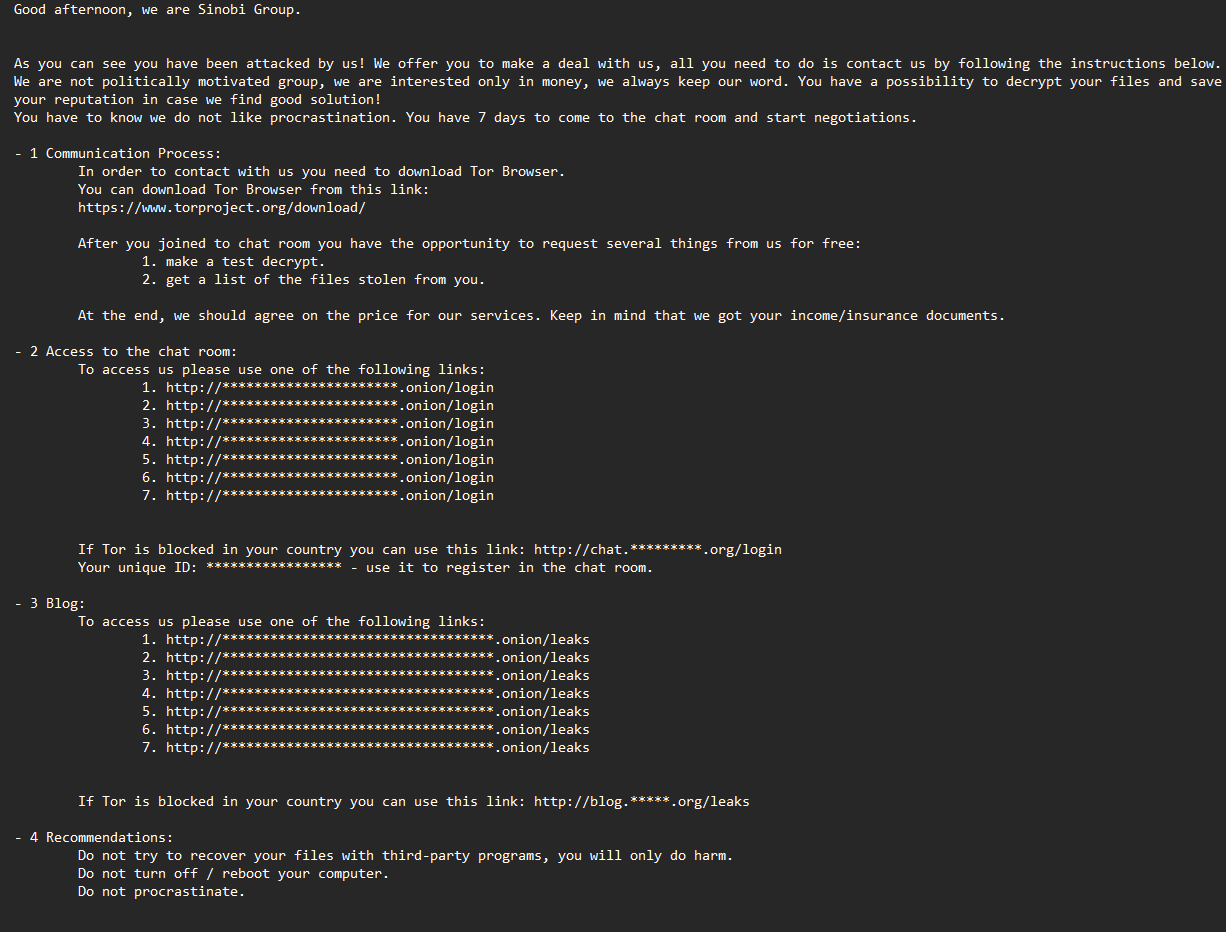
Good afternoon, we are Sinobi Group.
As you can see you have been attacked by us! We offer you to make a deal with us, all you need to do is contact us by following the instructions below.
We are not politically motivated group, we are interested only in money, we always keep our word. You have a possibility to decrypt your files and save your reputation in case we find good solution!
You have to know we do not like procrastination. You have 7 days to come to the chat room and start negotiations.
– 1 Communication Process:
In order to contact with us you need to download Tor Browser.
You can download Tor Browser from this link:
https://www.torproject.org/download/
After you joined to chat room you have the opportunity to request several things from us for free:
1. make a test decrypt.
2. get a list of the files stolen from you.
At the end, we should agree on the price for our services. Keep in mind that we got your income/insurance documents.
– 2 Access to the chat room:
To access us please use one of the following links:
1. http://**********************.onion/login
2. http://**********************.onion/login
3. http://**********************.onion/login
…
If Tor is blocked in your country you can use this link: http://chat.*********.org/login
Your unique ID: ***************** – use it to register in the chat room.
– 3 Blog:
To access us please use one of the following links:
1. http://**********************************.onion/leaks
2. http://**********************************.onion/leaks
3. http://**********************************.onion/leaks
…
If Tor is blocked in your country you can use this link: http://blog.*****.org/leaks
– 4 Recommendations:
Do not try to recover your files with third-party programs, you will only do harm.
Do not turn off / reboot your computer.
Do not procrastinate.
Early warning signs
The attack phases described above also serve as detection opportunities. Security teams should monitor for the following patterns, which commonly precede ransomware deployment:
- Unexpected administrator account creation or privilege escalation
- Security tool tampering or service disruption
- Unusual Active Directory or credential store queries, including Windows Credential Manager access
- Large outbound data transfers or unexpected cloud sync activity
- Remote access from unfamiliar accounts or locations
When these indicators appear in combination, an attack may be imminent. Early response actions to revoke compromised credentials, block external connections, and isolate affected hosts can significantly mitigate the impact.
Indicators of compromise (IOCs)
The following artifacts typically confirm that a Sinobi intrusion is active or has already occurred. Unlike early warning signs, these indicators generally appear during or after ransomware execution.
File and persistence artifacts
- Encrypted files with “.SINOBI” extension
- “README.txt” ransom notes in affected directories
- Modified desktop wallpaper displaying ransom text
Process and tool indicators
- rclone.exe execution with command-line flags for remote copy operations
- net.exe commands for user or group manipulation
- Uninstaller utilities targeting security software
- AnyDesk or similar remote access tools on systems where they are not typically installed
- Mass termination of database, backup, and email service processes
Network indicators
- Large data transfers to cloud storage providers or unknown external IP addresses
- Traffic to Tor entry nodes or clear-web mirrors of ransomware leak sites
- Unusual outbound transfers via SSH tunnels or cloud storage services
Because Sinobi emerged relatively recently and maintains strict operational security, static indicators such as specific file hashes remain limited. Defenders should prioritize behavioral detection and correlation rules over signature-based approaches.
Incident response considerations
Responding to a Sinobi incident requires swift containment and preservation of evidence. Organizations should understand how to handle a ransomware attack before it occurs.
Immediate isolation: Disconnect compromised hosts from the network. Disable or reset any suspicious accounts, including newly created administrator accounts. Identify and remove any unauthorized remote access tools.
Evidence preservation: Collect logs and memory images before rebooting or wiping systems. Note that Sinobi may clear logs as part of defense evasion, so rapid collection is critical. Important sources include VPN access logs, Windows event logs for account changes, and network transfer logs. Proper digital forensics practices are essential for both recovery and potential legal proceedings.
Credential revocation: Change passwords and rotate all credentials that may have been exposed. Implement MFA on critical accounts if it is not already in place.
Scope assessment: Use threat hunting to map lateral movement. Check for IOCs across the entire network and assume attackers may have reached any system reachable from the initial foothold.
Specialist engagement: Involve internal or external incident response teams. Given Sinobi’s data exfiltration component, notify legal and compliance functions as regulators may require breach disclosure. No public decryption method currently exists for Sinobi-encrypted files.
Recovery planning
Sinobi deletes volume shadow copies using low-level DeviceIoControl APIs, empties the Recycle Bin, and terminates backup-related processes, including Veeam and SQL services, making restoration through standard Windows features impossible. A professional ransomware recovery evaluation can help determine available options.
Identify any isolated or offline backups that predate the attack. On-premises backups connected to the production network may be unusable. Once the environment is confirmed to be secure, prioritize restoring critical systems from verified, clean backups.
The impact of data exfiltration often extends beyond operational disruption. Regulatory notification and compliance obligations may apply, and victims may experience extended downtime and additional long-term consequences from data exposure.
Hardening and prevention
Defending against Sinobi requires strengthening controls across the attack chain through established cybersecurity best practices.
Remote access controls: Avoid granting domain admin rights to VPN or RDP accounts. Third-party and MSP accounts should follow the principle of least privilege. Enforce MFA on all remote access methods. Restrict or monitor the use of remote management tools.
Patch management: Prioritize updates for VPN appliances and public-facing systems. The SonicWall vulnerability used as an entry point would have been mitigated by timely patching.
Endpoint protection: Configure EDR solutions with anti-tampering options. Avoid storing uninstall credentials or configurations for security tools on accessible network shares.
Network segmentation: Isolate high-value resources, such as domain controllers and critical servers, into separate network segments with strict access controls. This limits lateral movement from a single compromised account.
Data exfiltration controls: Implement egress filtering and data loss prevention measures to detect or block unauthorized transfers. Monitor for cloud sync tools, such as RClone, that Sinobi uses to exfiltrate data prior to encryption.
Monitoring and detection: Deploy behavioral analytics to flag multiple file encryptions or large data transfers. Because Sinobi relies heavily on living-off-the-land techniques using legitimate administrative tools, signature-based detection alone is insufficient. Consider managed detection and response services for continuous monitoring. Monitor for unauthorized remote access tools.
Backup resilience: Maintain offline, immutable backups isolated from the production network. Test restore processes regularly to ensure recovery capability.
Conclusion
Sinobi exemplifies the current state of ransomware operations: professional, disciplined, and optimized for financial return. The group’s rapid growth since mid-2025 demonstrates how quickly a well-organized operation can establish itself as a significant threat.
The technical overlap between Sinobi and earlier ransomware families illustrates a broader trend: ransomware operations rarely disappear entirely. Instead, they evolve, rebrand, and adapt their tooling while retaining effective tactics. For defenders, this means that lessons learned from one threat often apply to its successors.
The vulnerabilities exploited by Sinobi are addressable through disciplined security practices. Organizations that prioritize identity controls, timely patching, and backup isolation will be better positioned to withstand this threat. For those facing an active incident, professional incident response services can provide the expertise required for effective containment and recovery.